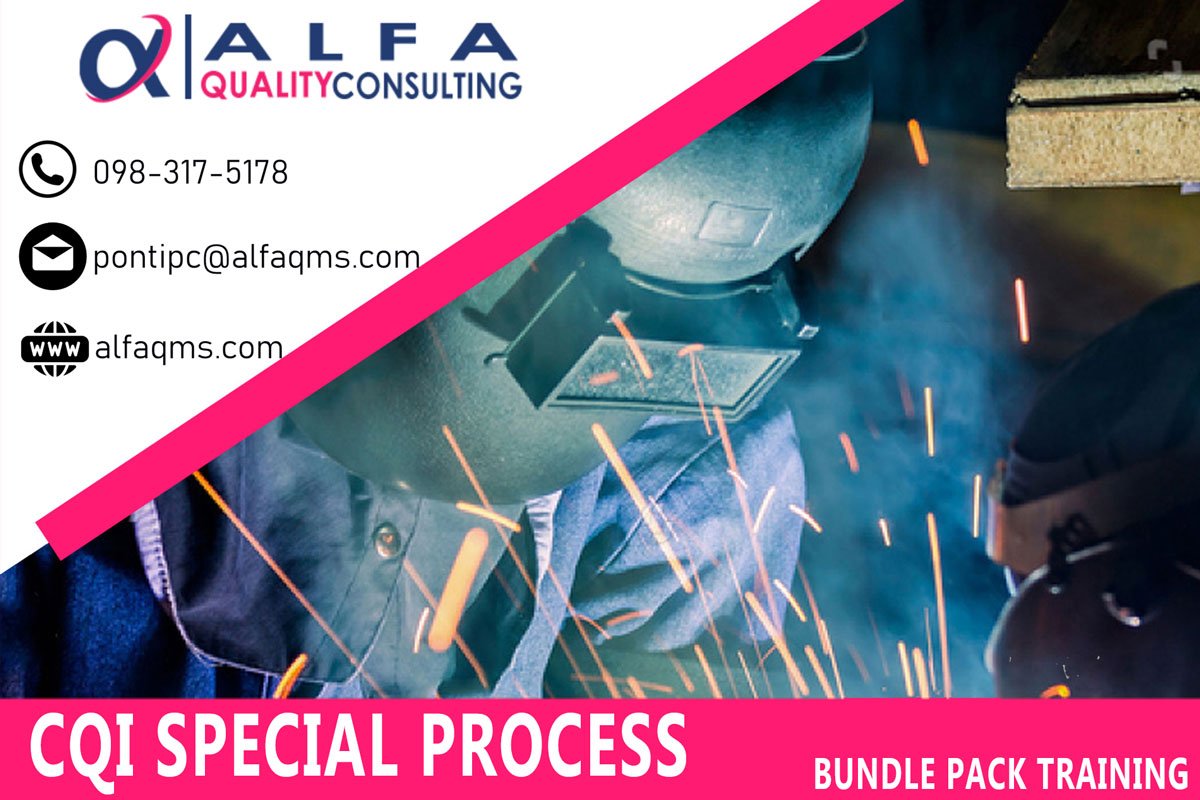
CQI Special Processes
Continuous Quality Improvement for Critical Manufacturing
1. History and Evolution
The Continuous Quality Improvement (CQI) standards were developed by the AIAG Special Processes Task Force in the early 2000s. Automotive OEMs recognized that traditional QMS audits (like ISO 9001 or IATF 16949) were insufficient for evaluating "special processes"—manufacturing steps where the output cannot be fully verified by subsequent inspection or testing. The first standard, CQI-9 for Heat Treat, was published to address catastrophic field failures caused by inadequate thermal processing. Since then, the framework has expanded to include plating, coating, welding, molding, casting, and more, creating a comprehensive, industry-wide system for auditing and validating the most critical, hidden processes in the automotive supply chain.
2. Scope and Application
CQI standards apply to any organization performing special processes, whether in-house or outsourced to sub-tier suppliers. They are mandated by major global OEMs (GM, Ford, Stellantis, VW, etc.) and are a critical component of supplier quality management. The scope encompasses process validation, equipment capability, personnel competence, and the systematic control of process parameters that directly affect the metallurgical, chemical, or structural integrity of the final product.
3. Definitions and Terminology
| Term | Definition |
|---|---|
| Special Process | A process where the output cannot be fully verified by subsequent monitoring or measurement (e.g., heat treat, welding, plating). |
| Process Table | The specific audit checklist and requirements for a given CQI standard. |
| Self-Assessment | A mandatory internal audit conducted by the supplier against the CQI process table. |
| Process Audit | An on-site evaluation by the customer or third party to verify CQI compliance. |
| Objective Evidence | Documented records, charts, and physical observations proving process control. |
4. Fundamental Concepts
The theoretical foundation of the CQI framework is rooted in the physics of manufacturing and the limitations of traditional quality inspection. In a standard machining process, a defective part can be caught by a CMM or a go/no-go gage at the end of the line. However, in a special process like heat treatment or welding, the critical quality characteristics (e.g., case depth, microstructure, internal weld penetration) are hidden inside the material. Destructive testing can verify a sample, but it cannot guarantee the integrity of every single part produced. Therefore, the CQI philosophy shifts the quality paradigm from "detect and sort" to "validate and control the physics of the process."
The Philosophy of Process Validation
Because the output cannot be fully verified, the process itself must be rigorously validated and continuously monitored. The CQI standards demand that organizations prove their equipment is capable of maintaining the exact physical conditions (temperature, atmosphere, pressure, time) required to achieve the desired material transformation. This involves concepts like Temperature Uniformity Surveys (TUS), System Accuracy Tests (SAT), and rigorous preventive maintenance. The theoretical insight is that in special processes, the equipment and the environment are the quality control system.
The Structure of CQI Assessments
Each CQI standard utilizes a "Process Table" divided into distinct sections: Section 1 (Management & Quality Planning), Section 2 (Job Shop / Material Handling), Section 3 (Equipment), and Section 4 (Process-specific controls). The assessment is not a simple pass/fail checklist; it requires the auditor to evaluate the depth of the organization's understanding of the process physics. An auditor must ask not just "Is the temperature recorded?" but "What is the reaction plan if the thermocouple fails, and how do you validate the metallurgical outcome?"
Personnel Competence and Metallurgical/Chemical Knowledge
A unique theoretical requirement of CQI is the mandate for specialized personnel competence. Unlike general assembly, special processes require operators and engineers who understand the underlying science (e.g., metallurgy for heat treat, chemistry for plating). The CQI standards explicitly require the organization to identify a "Special Process Owner" or engineer with the authority and technical knowledge to manage the process, troubleshoot anomalies, and validate equipment.
When and Where CQI Applies
CQI applies to any supplier performing a special process, from Tier 1 OEM suppliers to Tier 3 sub-tier job shops. It is triggered during supplier selection, new product introduction (APQP), and as a corrective action requirement when quality escapes occur. Compliance is typically verified through an annual self-assessment and periodic on-site customer audits.
5. Manufacturing Applications
CQI standards are applied to manage and validate heat treat furnaces, plating bath chemistries, welding parameter controls, injection molding process windows, and casting melt quality. They dictate the calibration of sensors, the frequency of bath analysis, the qualification of operators, and the containment strategies for nonconforming material.
6. Implementation Guide
- Identify all special processes performed in-house and by sub-tier suppliers.
- Obtain the relevant CQI standards (e.g., CQI-9, CQI-11, CQI-15) and customer-specific requirements.
- Appoint a qualified Special Process Engineer/Owner.
- Conduct a gap analysis against the CQI Process Table.
- Implement rigorous equipment validation (e.g., TUS/SAT for furnaces, bath analysis for plating).
- Develop specialized training programs for operators and technicians.
- Execute an annual self-assessment and document findings.
- Implement corrective actions for any non-conformances and verify effectiveness.
7. Required Documentation
CQI Self-Assessment Reports, Equipment Validation Records (TUS, SAT, Bath Analysis), Operator Competency Matrices, Process Parameter Monitoring Logs, Preventive Maintenance Schedules, and Corrective Action Plans.
8. Audit Preparation
Ensure the Special Process Owner is available and can demonstrate deep technical knowledge. Verify that all equipment validation records are current and traceable. Check that operators are trained not just on the work instructions, but on the reaction plans for out-of-spec conditions. Review the self-assessment to ensure it was thorough and not just a "pencil whip" exercise.
9. Industrial Examples
A Tier 2 gear manufacturer faced a major customer audit under CQI-9. By proactively implementing the CQI-9 4th edition requirements, including automated TUS data logging and strict atmosphere carbon potential controls, they not only passed the audit with zero non-conformances but also reduced their scrap rate by 22% due to improved process stability.
10. Common Mistakes
- Treating the CQI self-assessment as a paperwork exercise rather than a technical deep-dive.
- Failing to appoint a qualified Special Process Engineer with actual authority.
- Neglecting sub-tier suppliers who perform special processes on the organization's behalf.
- Ignoring the reaction plans and focusing only on the equipment calibration.
- Not understanding the underlying physics/chemistry of the specific special process.
11. Integration with Other Standards
CQI integrates directly with IATF 16949 (Clause 8.5.1.5 - Total productive maintenance, Clause 8.5.1.6 - Production tooling), APQP/PPAP (process validation), and customer-specific requirements (CSR). It serves as the technical supplement to the general QMS requirements for high-risk manufacturing steps.
12. Frequently Asked Questions
Q: If we outsource our heat treat, do we still need to know CQI-9?
A> Yes. Under IATF 16949 and CQI-19 (Sub-Tier Supplier Management), the Tier 1 supplier is ultimately responsible for the quality of outsourced special processes. You must require your sub-tier to perform CQI-9 self-assessments and conduct second-party audits to verify their compliance.
13. Certification Preparation
Demonstrate a mature understanding of the process physics. Show complete equipment validation records. Provide evidence of specialized operator training. Verify that the annual self-assessment was conducted by a competent internal auditor and that all gaps were closed with effective corrective actions.
14. Future Trends
The future of CQI involves digital integration, where furnace controllers and plating bath sensors feed data directly into cloud-based CQI compliance dashboards. AI-driven predictive maintenance will be used to forecast equipment degradation before it causes an out-of-spec condition, moving the industry from reactive validation to continuous, real-time process assurance.
Article Created by AlfaQMS Thailand
© 2026 Alfa Quality Consulting Thailand Co., Ltd. All rights reserved.
Leave a Comment